


Cognitive Behavioral Therapy for Insomnia (CBT-I): Why Behavioral Sleep Therapy Outperforms Pills
- Nov 17, 2025
- 9 min read
Introduction
Insomnia is one of the most common sleep disorders worldwide, affecting 10–15% of adults chronically. For decades, the default first-line approach has been pharmacological—benzodiazepines, non-benzodiazepine hypnotics, or melatonin. These drugs can bring short-term relief but often fail to deliver lasting benefits. Tolerance, dependency, and side effects further erode their utility. In contrast, Cognitive Behavioral Therapy for Insomnia (CBT-I) has emerged as the gold standard, consistently recommended by international guidelines as the first-line treatment for chronic insomnia1,2.
CBT-I differs from medication by addressing the root mechanisms of insomnia—maladaptive behaviors and cognitive distortions that perpetuate sleeplessness. It teaches patients to unlearn insomnia, retraining both body and mind to associate bed with restorative sleep. Beyond clinical efficacy, CBT-I is flexible: it can be delivered in person, in groups, or digitally, and can be tailored across life stages.
Importantly, mounting research shows CBT-I’s effects are amplified when combined with sensory-based interventions such as circadian-aligned light, personalized soundscapes, and cooling strategies3–6. These approaches target environmental burdens—light pollution, noise, and heat—that can undermine even the best behavioral plans. As climate change, urbanization, and screen exposure reshape sleep environments, integrating CBT-I with sensory dosing is increasingly essential for population-level sleep health7–9.
Mechanisms of Insomnia
Insomnia is not just the absence of sleep—it is a conditioned state of hyperarousal. Cognitive models emphasize that failed attempts to sleep create anticipatory anxiety, which conditions the bed into a cue for wakefulness. Physiologically, insomnia reflects dysregulation of both circadian timing and homeostatic drive. Evening device light suppresses melatonin and delays circadian phase10,11. Hyperactivation of the sympathetic nervous system elevates heart rate and reduces variability, prolonging sleep onset and fragmenting continuity12,13.
The sensory environment often intensifies these mechanisms. Noisy dormitories, overheated bedrooms, or e-reader use at night impose exogenous burdens that increase arousal, delay circadian timing, and impair sleep efficiency7,8,14. For patients with comorbid PTSD, depression, or chronic pain, insomnia becomes doubly entrenched: intrusive thoughts and physiological hyperactivation overlap with maladaptive coping behaviors (e.g., alcohol, late-night scrolling), perpetuating the cycle.
CBT-I addresses these mechanisms by targeting both the behavioral scaffolding (when, where, and how one sleeps) and the cognitive scaffolding (what one believes about sleep).
Core Elements of CBT-I
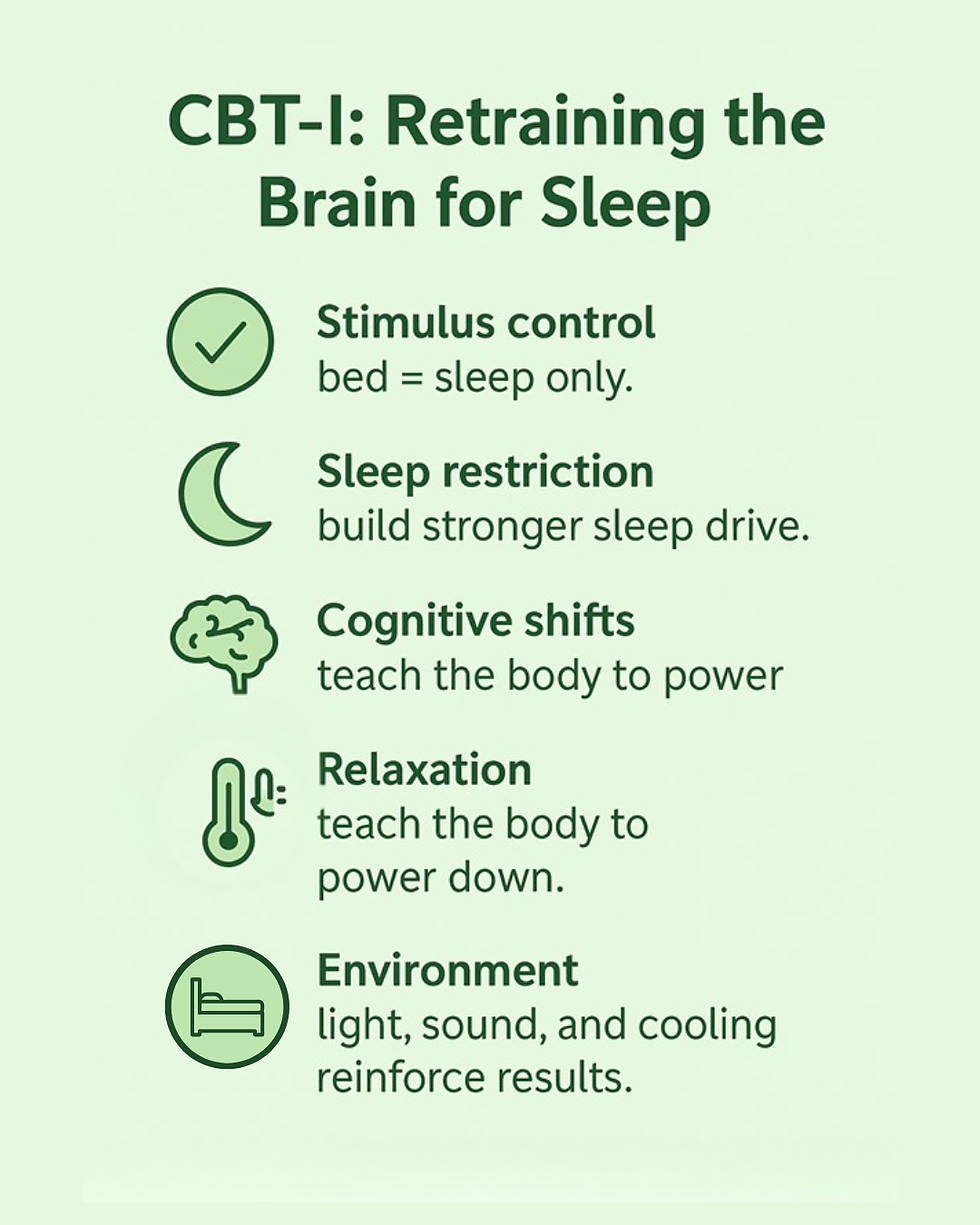
1. Stimulus Control – reconditioning the bed to serve only as a sleep cue. Rules include leaving the bed when unable to sleep, restricting the bedroom to sleep and sex, and maintaining consistent wake times. When paired with sensory cues (dim evening lighting, pre-sleep sound routines), stimulus control gains additional associative power15,16.
2. Sleep Restriction (Compression) – paradoxically limiting time in bed to build sleep pressure and consolidate sleep. Though initially fatiguing, sleep restriction increases efficiency and decreases nocturnal wakefulness over time2. Integration with cooling strategies (cool bedding, pre-sleep cooling) can offset fatigue and improve adherence17,18.
3. Cognitive Restructuring – challenging catastrophic thoughts (“I’ll never sleep again”) with realistic expectations. Adjunct bright light therapy has been shown to reinforce restructuring by aligning circadian timing and improving self-efficacy19.
4. Relaxation Training – including mindfulness, progressive muscle relaxation, or breathing exercises, designed to lower physiological arousal. Predictable soundscapes, ASMR, or thermal cooling similarly shift autonomic tone toward parasympathetic activation, enhancing relaxation’s effectiveness20,21.
5. Sleep Hygiene Education – guidance on caffeine, alcohol, exercise, and light exposure. While hygiene alone rarely cures insomnia, it provides the context within which CBT-I operates most effectively22.
Evidence Base
The efficacy of CBT-I is robust and well-documented. In a systematic review of over 30,000 participants across 241 randomized controlled trials, CBT-I significantly improved sleep efficiency, reduced sleep latency, shortened wake after sleep onset, and enhanced long-term remission rates of chronic insomnia1,2.
Importantly, CBT-I outperforms pharmacotherapy over the long term. While medications offer transient relief, relapse is common upon discontinuation. CBT-I, by contrast, imparts durable skills, enabling patients to maintain sleep improvements for years.
CBT-I also proves effective across comorbid populations:
· Depression & Anxiety: Insomnia predicts higher relapse risk in depression, and CBT-I reduces both insomnia and mood symptoms simultaneously23.
· PTSD: Veterans using CBT-I combined with relaxation and cooling reported decreased anxiety and depression along with improved sleep24.
· Chronic Pain: Mind-body CBT-I protocols incorporating relaxation reduced pain-related sleep disruption and improved quality of life25.
· Neurodevelopmental Disorders: Adapted CBT-I protocols improve sleep in children with ADHD and autism, particularly when combined with sensory adjustments26,27.
This breadth reinforces CBT-I as a cornerstone therapy with wide applicability.
Integration with Sensory-Based Interventions
While CBT-I establishes the behavioral framework, sensory interventions provide the physiological tailwind. Recent evidence emphasizes that nights burdened by light, noise, or heat reduce sleep efficiency by 3.2–4.7%, and climate projections estimate ~58 hours/year of sleep lost per person by late century7. These burdens can blunt CBT-I’s benefits unless explicitly addressed.
Light
Light is the most powerful circadian zeitgeber. Morning bright light (>2,500 lux) advances circadian phase and consolidates sleep; evening blue light delays melatonin and impairs sleep onset10,28. CBT-I’s set wake times are strengthened when paired with dawn simulation, reducing sleep inertia and stabilizing rhythms29,30. For delayed-sleep adolescents, bright morning light plus CBT-I improved latency, total sleep time, and daytime fatigue19.
Sound
The auditory system remains active during sleep, rendering it a double-edged sword. Continuous white/pink/brown noise can mask environmental disruptions, especially in “peaky” environments (dorms, hospitals), but may lighten sleep in quiet settings5,31,32. Personalized soundscapes (nature sounds, music, ASMR) reduce sympathetic tone, lower cortisol, and improve sleep depth in ICU and post-surgical populations33–35. Closed-loop auditory stimulation, synchronized to slow-wave oscillations, can enhance deep sleep and memory consolidation36.
For CBT-I patients, sound routines act as predictable anchors—cueing relaxation and reinforcing bedtime rituals, especially in children with sensory sensitivities27.
Temperature
Sleep onset relies on a nocturnal decline in core temperature. Cooling strategies—ventilation, cold bedding, forehead cooling devices—facilitate this physiological drop and improve efficiency12,17,38. Cooling is especially effective in menopause, endocrine therapy for cancer, and veterans with insomnia. Localized cooling (forehead or head) not only improves sleep but also alleviates migraine/headache burden38-39.
When paired with CBT-I’s sleep restriction (which initially increases fatigue), cooling reduces dropout and supports adherence18.
Clinical Application
For therapists, CBT-I should be positioned not as a specialized niche therapy but as a foundational skill set relevant across clinical practice. Steps include:
· Screen for insomnia at intake; up to 80% of depressed patients report significant sleep complaints23.
· Normalize sleep as a therapy goal; poor sleep is not just a symptom but a driver of relapse.
· Embed simple CBT-I principles (consistent wake times, stimulus control) in therapy.
· Refer to specialists or recommend digital CBT-I when full programs are needed.
· Layer sensory prescriptions:
o Light: device curfews, warm-spectrum evening bulbs, morning light walks.
o Sound: soothing nature or music in high-arousal patients; masking only in noisy environments.
o Temperature: cooling bedding for menopause; localized forehead cooling for migraines.
Clinical vignette:
· A 52-year-old woman with menopause-related insomnia. Standard CBT-I produced modest gains but adherence faltered due to nighttime hot flashes. Adding a cooling mattress pad and reinforcing stimulus control improves efficiency and reduces awakenings.
· A veteran with PTSD using CBT-I reported persistent hyperarousal. Integration of pre-sleep ASMR and a forehead cooling device reduces anxiety and improves continuity.
Future Directions
Despite extensive evidence for CBT-I and individual sensory tools, gaps remain. Most trials still test light, sound, or temperature in isolation, and few evaluate combined sensory bundles layered on CBT-I. Effects also vary by context—what works in noisy dorms may harm in quiet homes—so trials must stratify by baseline sensory burdens. Clinical protocols further lack clear dosing rules for spectrum, timing, decibel levels, or temperature targets, leaving clinicians to improvise.
Digital CBT-I platforms, however, open possibilities for scalable multimodal toolkits: filters and dawn lamps for circadian alignment, curated sound libraries for relaxation or masking, and cooling textiles for thermal comfort. As climate change progresses—with projections of ~58 hours of sleep lost per person annually due to warming nights by late century7—integrating cooling and ventilation into behavioral therapy is no longer optional but a public health priority.
Ultimately, CBT-I remains the backbone of insomnia treatment: durable, skill-based, and effective across populations. Yet environmental burdens—bright screens, noisy homes, overheated nights—can blunt behavioral gains unless directly addressed. Layering sensory prescriptions onto CBT-I provides patients with comprehensive, low-risk, and scalable solutions.
The future of sleep medicine lies in integration: skills + senses. A 24-hour care model that combines stimulus control, structured light exposure, context-matched sound, and cool, ventilated sleep environments offers the strongest evidence-based pathway to restorative sleep and better mental health.
References
Alimoradi Z, Jafari E, Brostrom A, Ohayon MM, Lin CY, Griffiths MD, et al. Effects of cognitive behavioral therapy for insomnia (CBT-I) on quality of life: A systematic review and meta-analysis. Sleep Med Rev. 2022;64:101646.
Furukawa Y, Sakata M, Yamamoto R, Nakajima S, Kikuchi S, Inoue M, et al. Components and Delivery Formats of Cognitive Behavioral Therapy for Chronic Insomnia in Adults: A Systematic Review and Component Network Meta-Analysis. JAMA Psychiatry. 2024;81(4):357-65.
Riemann D, Espie CA, Altena E, Arnardottir ES, Baglioni C, Bassetti CLA, et al. The European Insomnia Guideline: An update on the diagnosis and treatment of insomnia 2023. J Sleep Res. 2023;32(6):e14035.
Hubler A. Influence of Sensory Needs on Sleep and Neurodevelopmental Care in At-Risk Neonates. Children (Basel). 2025;12(6).
Riedy SM, Smith MG, Rocha S, Basner M. Noise as a sleep aid: A systematic review. Sleep Med Rev. 2021;55:101385.
Basner M, Smith MG, Jones CW, Ecker AJ, Howard K, Schneller V, et al. Associations of bedroom PM2.5, CO2, temperature, humidity, and noise with sleep: An observational actigraphy study. Sleep Health. 2023;9(3):253–263.
Minor K, Bjerre-Nielsen A, Jonasdottir SS, Lehmann S, Obradovich N. Rising temperatures erode human sleep globally. One Earth. 2022;5(5):534–549.
Lin S, Lipton E, Lu Y, Kielb C. Are classroom thermal conditions, lighting, and acoustics related to teacher health symptoms? Indoor Air. 2020;30(3):544–552.
Sanchez-Cano A, Luesma-Bartolomé MJ, Solanas E, Orduna-Hospital E. Comparative Effects of Red and Blue LED Light on Melatonin Levels During Three-Hour Exposure in Healthy Adults. Life. 2025;15(5):715.
Chang AM, Aeschbach D, Duffy JF, Czeisler CA. Evening use of light-emitting eReaders negatively affects sleep, circadian timing, and next-morning alertness. Proc Natl Acad Sci U S A. 2015;112(4):1232–1237.
Zisapel N. Circadian rhythm sleep disorders: pathophysiology and potential approaches to management. CNS Drugs. 2001;15(4):311–28.
Bigalke JA, Cleveland EL, Barkstrom E, Gonzalez JE, Carter JR. Core body temperature changes before sleep are associated with nocturnal heart rate variability. J Appl Physiol (1985). 2023;135(1):136-45.
Szymusiak R. Body temperature and sleep. Handb Clin Neurol. 2018;156:341–51.
Dong R, Xu Y, Zhu R. Heterogeneous effects of artificial light at night on sleep and mental health: 2SLS augmented geospatial data modeling and geo-correlation analysis. Health Place. 2025;95:103504.
Swanson LM, Raglan GB. Circadian Interventions as Adjunctive Therapies to Cognitive-Behavioral Therapy for Insomnia. Sleep Med Clin. 2023;18(1):21-30.
Sharma MP, Andrade C. Behavioral interventions for insomnia: Theory and practice. Indian J Psychiatry. 2012;54(4):359-66.
Avis NE, Levine BJ, Coeytaux R. Results of a pilot study of a cooling mattress pad to reduce vasomotor symptoms and improve sleep. Menopause. 2022;29(8):973-8.
Herberger S, Penzel T, Fietze I, Glos M, Cicolin A, Fattori E, et al. Enhanced conductive body heat loss during sleep increases slow-wave sleep and calms the heart. Sci Rep. 2024;14(1):4669.
Gradisar M, Dohnt H, Gardner G, Paine S, Starkey K, Menne A, et al. A randomized controlled trial of cognitive-behavior therapy plus bright light therapy for adolescent delayed sleep phase disorder. Sleep. 2011;34(12):1671–80.
Sakurai N, Ohno K, Kasai S, Nagasaka K, Onishi H, Kodama N. Induction of Relaxation by Autonomous Sensory Meridian Response. Front Behav Neurosci. 2021;15:761621.
Yoon H, Baek HJ. External Auditory Stimulation as a Non-Pharmacological Sleep Aid. Sensors (Basel). 2022;22(3).
Walker J, Muench A, Perlis ML, Vargas I. Cognitive Behavioral Therapy for Insomnia (CBT-I): A Primer. Klin Spec Psihol. 2022;11(2):123-37.
Palagini L, Hertenstein E, Riemann D, Nissen C. Sleep, insomnia and mental health. J Sleep Res. 2022;31(4):e13628.
Mysliwiec V, Neylan TC, Chiappetta L, Nofzinger EA. Effects of a forehead cooling device in veterans with chronic insomnia disorder and co-morbid medical and psychiatric conditions: a pilot study. Sleep Breath. 2021;25(1):441-8.
Doorley J, Greenberg J, Stauder M, Vranceanu AM. The role of mindfulness and relaxation in improved sleep quality following a mind-body and activity program for chronic pain. Mindfulness (N Y). 2021;12(11):2672-80.
Lane SJ, Leao MA, Spielmann V. Sleep, Sensory Integration/Processing, and Autism: A Scoping Review. Front Psychol. 2022;13:877527.
Kashefimehr B, Kayihan H, Huri M. The Effect of Sensory Integration Therapy on Occupational Performance in Children With Autism. OTJR (Thorofare N J). 2018;38(2):75-83.
Sun SY, Chen GH. Treatment of Circadian Rhythm Sleep-Wake Disorders. Curr Neuropharmacol. 2022;20(6):1022-34.
Terman M, Schlager D, Fairhurst S, Perlman B. Dawn and dusk simulation as a therapeutic intervention. Biol Psychiatry. 1989;25(7):966-70.
Tonetti L, Fabbri M, Erbacci A, Filardi M, Martoni M, Natale V. Effects of dawn simulation on attentional performance in adolescents. Eur J Appl Physiol. 2015;115(3):579-87.
Corrêa CDC, Weber SAT, Fidêncio VLD, Dos Santos EG, Fernandes LEO, Lopes RM, Abreu WF, Novanta GGR, Anna S, Weber T, et al. Objective effects of white noise on the sleep of university students: a pilot study. Rev Neurociências. 2024;32:1–14.
Vickrey B, Lerner I. Overnight exposure to pink noise could jeopardize sleep-dependent insight and pattern detection. Front Hum Neurosci. 2023;17.
Papathanassoglou E, Pant U, Meghani S, Saleem Punjani N, Wang Y, Brulotte T, et al. A systematic review of the comparative effects of sound and music interventions for intensive care unit patients' outcomes. Aust Crit Care. 2025;38(3):101148.
Kim J, Choi D, Yeo MS, Yoo GE, Kim SJ, Na S. Effects of patient-directed interactive music therapy on sleep quality in postoperative elderly patients: A randomized-controlled trial. Nat Sci Sleep. 2020.
Li Y, Ji S, Tao Y, Wang H, Wen Z, Liu L, Zhang X. The effect of music therapy on anxiety, depression, pain and sleep quality of lung cancer patients: a systematic review and meta-analysis. Support Care Cancer. 2025 Feb 10;33(3):169.
Esfahani MJ, Farboud S, Ngo HVV, Schneider J, Weber FD, Talamini LM, Dresler. Closed-loop auditory stimulation of sleep slow oscillations: Basic principles and best practices. Neurosci Biobehav Rev. 2023 Oct:153:105379.
Lan L, Tsuzuki K, Liu Y, Lian Z. Thermal environment and sleep quality: A review. Energy Build. 2017; 149:101–113.
Roth T, Mayleben D, Feldman N, Lankford A, Grant T, Nofzinger E. A novel forehead temperature-regulating device for insomnia: a randomized clinical trial. Sleep. 2018 May 1;41(5):zsy045.
Hsu YY, Chen CJ, Wu SH, Chen KH. Cold intervention for relieving migraine symptoms: A systematic review and meta-analysis. J Clin Nurs. 2023 Jun;32(11-12):2455-2465.